
An AC not cooling usually comes down to a short list of problems, and most of them give themselves away if you know where to look. Before anything else, answer two questions. Is the outdoor unit running? And is air coming out of the vents?
Those are among the first things we ask when someone calls about a warm house. The answers rule out half the possibilities before anyone is dispatched. A silent outdoor unit points somewhere very different from one that hums along while the vents blow lukewarm air.
Below, you’ll find what each combination usually means, the checks you can safely handle yourself, and what an HVAC contractor looks for once the easy fixes are ruled out.
Two Questions That Narrow It Down
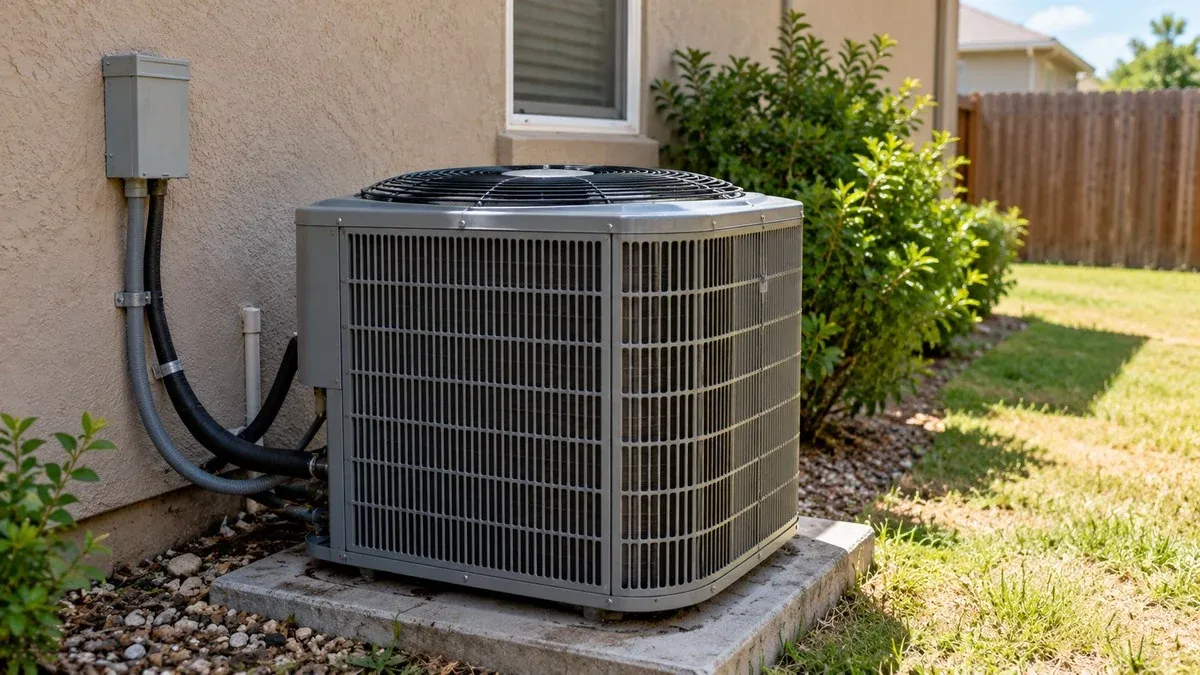
With the thermostat calling for cooling, hold your hand up to a supply vent. Then step outside to the condenser, the large unit with the fan on top. Here’s what the combinations usually point to:
| Outdoor unit | Air from the vents | Where to look |
| Silent | None | Thermostat, power to the system, or a drain safety switch that shuts everything down |
| Humming or clicking, fan not turning | Yes, not cold | An electrical part inside the outdoor unit |
| Running | Weak or barely any | Airflow: the filter, a frozen indoor coil, the blower, or the ductwork |
| Running | Strong, but not cold | Refrigerant charge, a dirty outdoor coil, or a compressor that isn’t engaging |
Make a note of what you saw. If you end up calling for service, it gives the technician a head start.
Should You Turn the AC Off?
Not necessarily. If the problem turns out to be a thermostat setting or a dirty filter, there’s no harm in letting it run. But switch it off at the thermostat and leave it off if you notice any of these:
- A burning or electrical smell from the vents or equipment
- An outdoor unit that buzzes or hums while the fan sits still
- Ice on the copper refrigerant lines or the indoor coil
- Water spilling from the drain pan or spotting the ceiling
- A breaker that trips again after you’ve reset it once
Running the system through any of those can damage the compressor, which is the most expensive part to replace.
Checks You Can Safely Do Yourself
Work through these in order. Most take a minute or two, and none of them involve opening a panel.
1. Look at the thermostat.
It should be on Cool, set a few degrees below the room temperature, with the fan on Auto. When the fan is set to On, the blower keeps pushing air between cooling cycles, and that uncooled air is easy to mistake for a breakdown. A blank screen usually means dead batteries. This time of year, it’s also worth checking whether a cool morning left it in Heat, or a smart thermostat schedule switched modes on its own.
2. Give it five minutes.
Many systems wait a few minutes before restarting the compressor after a power interruption or a setting change. The delay protects the compressor. If you just adjusted something, wait before deciding it isn’t working.
3. Check the filter and returns.
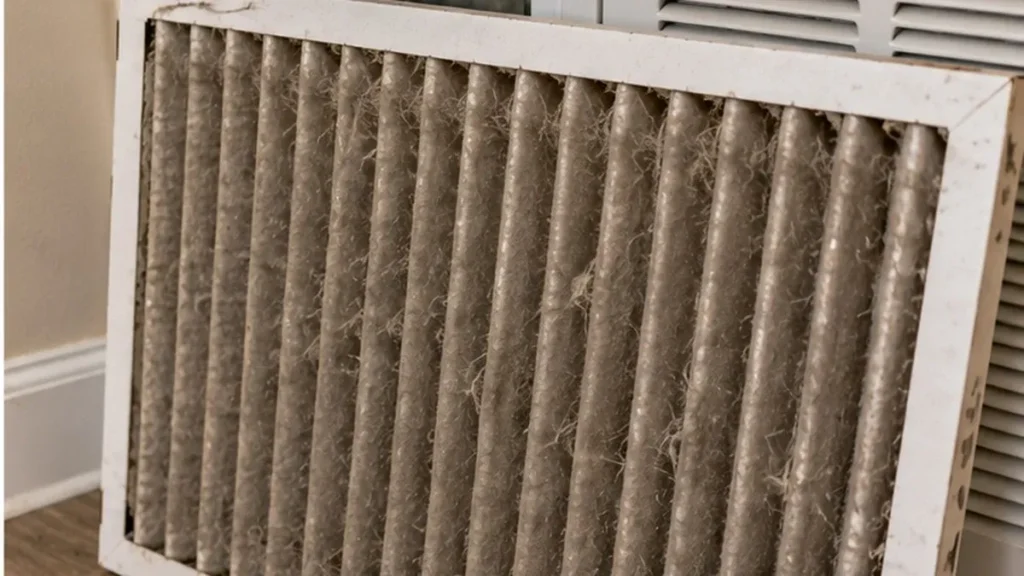
Pull the filter and hold it up to a light. If you can barely see through it, replace it. Then make sure furniture, rugs, or curtains aren’t blocking the return grilles.
4. Check breakers and switches.
Look for a tripped AC breaker in the main panel, then check the disconnect box mounted near the outdoor unit and the service switch by the indoor unit, which often looks like a light switch. Reset a tripped breaker once. If it trips again, leave it off and call.
5. Clear the outdoor unit.
Rake away leaves, grass clippings, and mulch, and keep shrubs trimmed back a couple of feet (your equipment manual lists the exact clearance). With the power off at the disconnect, rinse the coil with a gentle spray from a garden hose. Skip the pressure washer, because the fins bend easily. A thorough coil cleaning is part of routine AC maintenance.
6. Look in the drain pan.
In a lot of San Antonio homes, the indoor unit sits in the attic or a hall closet. Standing water in the pan underneath it suggests the drain line is clogged and a float switch has shut off cooling to keep the pan from overflowing. Leave the system off until the drain is cleared.
7. Thaw any ice.
Frost on the lines or the coil means airflow or refrigerant trouble. Turn cooling off, set the fan to On, and let it melt completely, which can take several hours. If it freezes again after you’ve put in a clean filter, it’s time for a technician.
When It’s More Than a Quick Fix
If the cold air still hasn’t come back, the cause is usually inside the equipment. At that point, these are the likely suspects.
Worn Electrical Parts in the Outdoor Unit
A capacitor gives the compressor and fan motor the boost they need to start, and a contactor switches power to them. Both wear out over time, and long stretches of triple-digit heat don’t help. A failing part often shows up as a unit that hums without the fan turning, or one that starts and clicks off a few seconds later.
Don’t push the fan blades to get them spinning, and don’t open the panel. A capacitor can hold a dangerous charge even with the power off. An AC repair visit lets a technician test each part and replace only what has actually failed.
A Refrigerant Leak
Refrigerant moves through a sealed loop and doesn’t get used up. If the charge is low, there’s a leak somewhere. The signs build slowly: cooling that weakens over weeks, longer run times, ice on the lines, sometimes a faint hiss near the equipment. Adding refrigerant without finding the leak only buys time.
Every Texas Air Repair technician is EPA 608 certified to handle refrigerant. We record the refrigerant charge when we service a system and leave the reading with you, so you can see the number instead of taking our word for it.
Airflow Problems a New Filter Won’t Fix
Sometimes the filter is clean, and the airflow is still weak. A struggling blower motor, a dirty indoor coil, or ductwork that’s crushed, kinked, or disconnected in the attic can all choke the system. To find out which, we measure static pressure, which shows how hard the blower is working to push air through the system. Think of it as a blood pressure reading for your ductwork.
When the readings point to the ducts rather than the equipment, air duct repair fixes the cause instead of asking the AC to work harder around it.
How Cold Should Your House Get on a 100-Degree Day?
An AC that can’t hold 72 at five in the afternoon in August isn’t necessarily broken. Home systems are sized for typical hot weather, not the very hottest afternoons. On those days, a healthy system may run almost nonstop and let the house drift a few degrees above the setting. What matters is whether it catches up after the sun goes down.
For a rough check, put a kitchen thermometer at a return grille, then at a nearby supply vent, after the system has run for about 15 minutes. A difference of roughly 15 to 20 degrees is commonly cited as normal. Humidity and airflow shift that number, so treat it as something to mention to a technician, not a diagnosis.
That gap is worth watching in the fall, too. Cooler October weather can make a struggling system look healthy simply because it isn’t working as hard. A slow leak or a weakening part won’t fix itself over the winter, and scheduling a repair now is far easier than during next summer’s first heat wave. If the system is older and the repair is a big one, fall is also a good time to compare a replacement without the pressure of a house that’s already too hot.
What to Expect When We Diagnose It
When you call, we’ll ask the same questions from the top of this article: whether anything is running, whether air is moving, and whether you’ve seen water, ice, or repeated shutoffs. Once on site, the technician starts with the thermostat and airflow, then traces the fault through the electrical components, drainage, and refrigerant circuit.
You’ll see what we find. We photograph the system before and after the work, record the refrigerant charge and static pressure readings, and leave a written summary of what was wrong, what we did, and what to keep an eye on next season. You’ll also get the price before any work begins.
If your house is heating up fast, especially with young children or older family members at home, call Texas Air Repair at 210-380-8000 about emergency AC repair. For anything less urgent, you can request service online.